
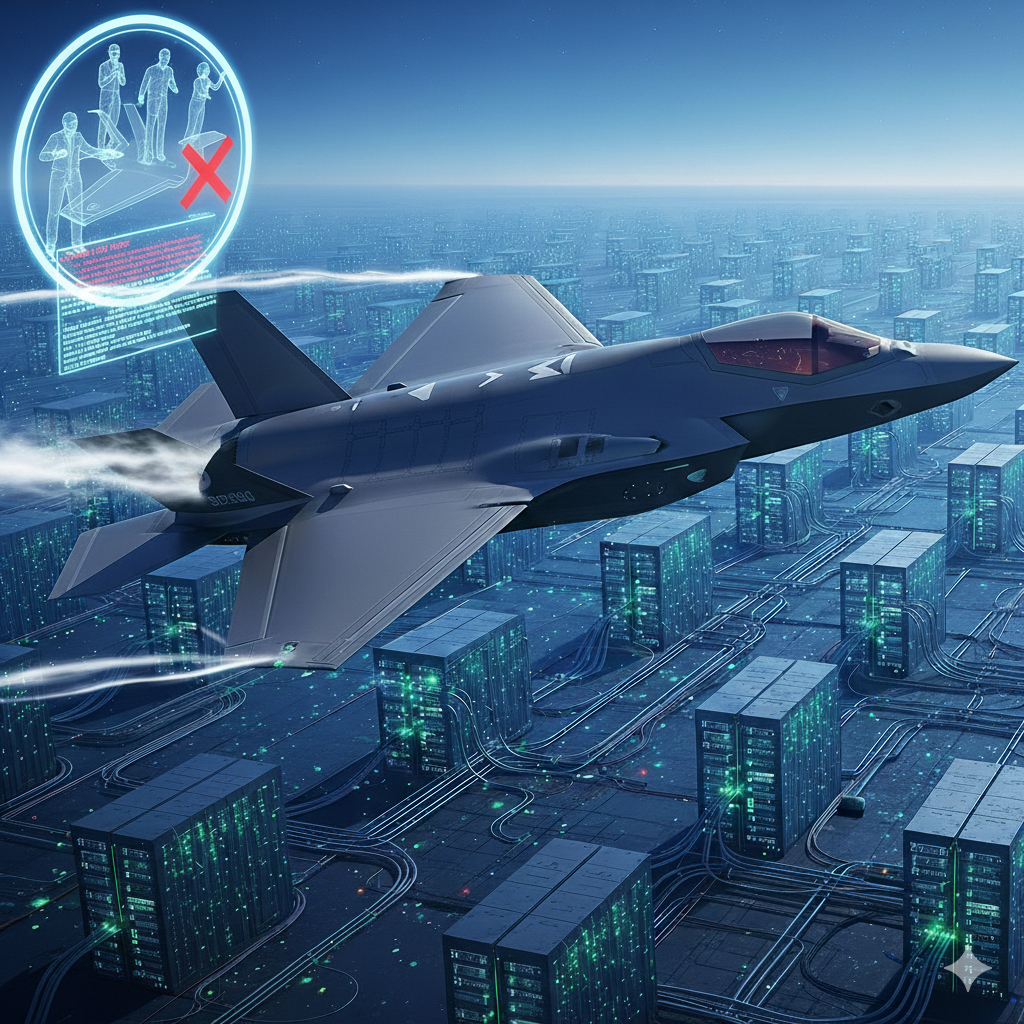
Imagine being thousands of feet in the air, in control of one of the world’s most advanced pieces of technology, when a critical system fails. Now, imagine spending nearly an hour on a support call with a team of experts, only for the call to end with you ejecting from a $200 million aircraft as it crashes to the ground.
This isn’t a movie script. It happened in August 2025, when an F-35A pilot was forced to do just that.
This dramatic incident serves as a powerful lesson for any business relying on complex technology. Even with the best hardware and expert support on the line, real-time troubleshooting has its limits. When a crisis hits, your survival depends on the proactive resilience strategies you built before the failure ever occurred.
A 50-Minute Call to Disaster: The F-35 Incident
The situation at Eielson Air Force Base in Alaska escalated quickly, revealing a chain of events that should make any business leader pause:
- The Initial Fault: Shortly after takeoff, the jet’s landing gear failed to retract.
- The Support Call: Unable to resolve the issue, the pilot initiated a real-time conference call with five Lockheed Martin engineers, which lasted nearly 50 minutes.
- The Root Cause: The problem was later confirmed to be frozen hydraulic fluid—a small, environmental detail with catastrophic consequences.
- The Final Failure: After two “touch-and-go” landing attempts advised by the team, the jet’s systems incorrectly registered it as being on the ground, triggering a total loss of flight control.
- The Result: The pilot ejected safely, but the state-of-the-art aircraft was destroyed.
This incident is a stark reminder that improvisation under pressure is not a strategy.
Your Business’s ‘Frozen Hydraulics’: The Real-World Parallels
While you aren’t flying a supersonic jet, the same principles of failure apply to your IT infrastructure. Your business has its own “frozen hydraulics”—small, overlooked details that can snowball into a complete operational meltdown. These can include:
- Unpatched systems that leave a door open for ransomware.
- “Silent” backup failures that go unnoticed until you desperately need to recover data.
- Untested disaster recovery plans that look great on paper but fail in a real crisis.
- Misconfigured automation that brings your operations to a halt.
When these things fail, you’re suddenly in that cockpit, trying to troubleshoot a disaster in real-time. But by then, it’s often too late.
The OZO Difference: Building Your IT Resilience Before Crisis Hits
At OZO Services, our entire philosophy is built around ensuring our clients never have to pull the “ejection handle.” We focus on proactive, preventative strategies that build resilience directly into your IT foundation.
- Proactive Prevention, Not Last-Minute Panic We don’t wait for alarms to go off. Our 24/7 monitoring and proactive maintenance anticipate issues before they become crises. We find and fix the “frozen hydraulics” in your system so you can fly smoothly.
- Canadian-Based Experts on Demand When you do need support, you’re not routed to an offshore call center. You get clear, direct communication with our Canadian team of real engineers who understand your business and your environment. No language barriers, no frustrating delays.
- A Tested, Resilient Strategy We go beyond basic backups. We design and regularly test comprehensive disaster recovery and business continuity plans. We ensure that if a system fails, your recovery is swift, predictable, and effective.
Don’t Wait for Your Ejection Moment
The lesson from the F-35 crash is simple: resilience isn’t about having experts to call during a disaster; it’s about having a partnership that prevents the disaster in the first place. Your IT infrastructure is too critical to leave to chance.
Don’t wait for a crisis to expose your vulnerabilities. Contact OZO Services today for a comprehensive IT resilience assessment and build a strategy that keeps your business secure, efficient, and flying high—no matter the conditions.